|
Page 3
|
Cost
|
Item Description
|
Click Picture
for Larger Image
|
|

|
$24.00
|
EGG308c
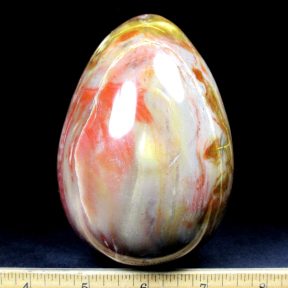
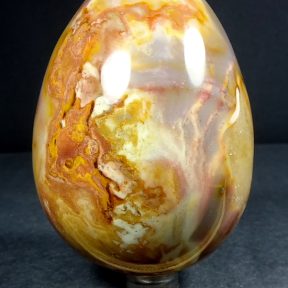
This is a very pretty, beautifully colored, Petrified Wood egg with
a very interesting pattern. It measures 2 1/8" x 1 5/8" with a
nice polish. This material is from Madagascar. This is something
different for the egg collector. Another
photo.
Petrified Wood is a type of a fossil as it consists of fossil wood where
all the organic materials have been replaced with minerals while retaining
the original structure of the wood. These minerals are most often Silicates
such as Quartz. Other minerals, Manganese, Iron and Copper, in the water
or mud during the petrification process gives Petrified Wood a variety of
color ranges: black - Carbon; green/blue - Copper; red/brown/yellow - Iron.
Petrified Wood can preserve the original structure of the wood in all its
detail all the way down to the microscopic level. Structures such as
tree rings and the various tissues are often observed features. Although
Petrified Wood can be found worldwide, it is rather rare in larger quantities
and at times can be difficult to obtain by the average collector.
|
Petrified Wood Egg
|
|

|
$25.00
|
EGG301b
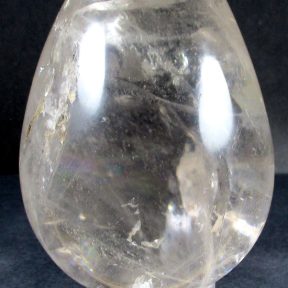
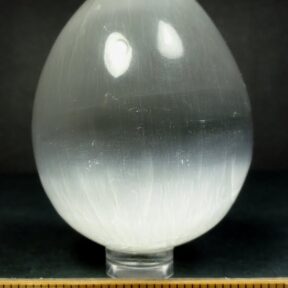
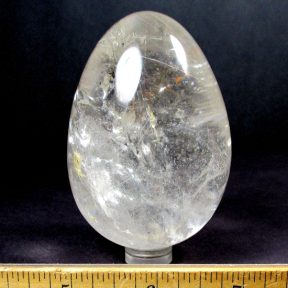
This is something different for the egg collector. Here is
a very nice, very clear Crystal Quartz egg. It measures 2 1/8" x 1 5/8"
and has a nice polish. This egg has good clarity and some internal and
external fractures which are quite common for this type of material.
It is a true beauty and displays well. A great starter egg for the new
egg collector. Another photo.
Quartz is the second most common mineral in the Earth's continental
crust. It is mainly composed of Silica or Silica based minerals.
Although Quartz is known by a variety of names, the most important distinction
between types of Quartz is that of macro-crystalline, individual crystals
visible to the unaided eye, and micro-crystalline, where aggregates of crystals
are only visible under high magnification. There are many forms of Quartz
including Chalcedony, Amethyst, Citrine, and Carnelian which are results of
mineral impurities or heat treatments.
|
Crystal Quartz Egg
|
|

|
$22.00
|
EGG306c
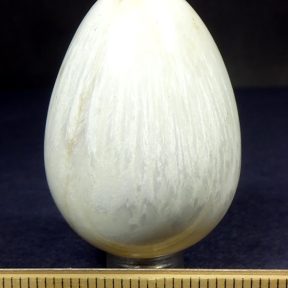
This is a Peruvian Stromatolite egg with a special botryoidal pattern.
The egg measures 2" x 1 1/2" in diameter. This egg has lines similar
to Tiger-Eye, but shows more of a floral like pattern. It has a nice
polish as well as good definition between the radiating lines of the Stromatolite.
Another photo.
Stromatolites are commonly thought to have been formed by the trapping,
binding, and cementation of sedimentary grains by microorganisms, especially
blue-green algae but very few actually contain fossilized microbes.
|

Stromatolite Egg
|
|

|
$15.00
|
EGG307c
This is an very nice Brown Aragonite egg. It measures
nearly 3" x 2" and has a nice polish. This egg has an interesting design
and an interesting ring-like pattern. Something different for the egg
collection. Aragonite is a Carbonate mineral that can occur in conjunction
with Calcium Carbonates. Aragonite differs from Calcite in the formation
of the Crystal shapes which can be in lattice, crystal, columnar or fibrous
in many different designs, shapes and sizes. Aragonite will form in
mollusk shells, oceans and salt water caves as inorganic precipitates called
marine cements and speleotherms. Ammolite is a form of Aragonite with
impurities that make it iridescent and valuable as a gemstone.
|

Aragonite Egg
|
|

|
$30.00
|
EGG310c
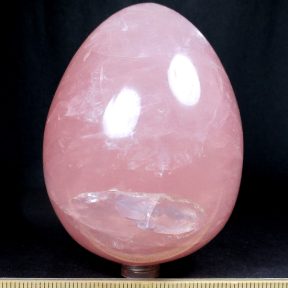
This is a pretty, above average quality Rose Quartz egg from
Madagascar. It measures 2 3/8" x 1 3/4" and has a nice polish. This
particular egg has a light Pink color and beautiful appearance. Quartz
is the second most common mineral in the Earth's continental crust.
It is mainly composed of Silica or Silica based minerals. Although Quartz
is known by a variety of names, the most important distinction between types
of Quartz is that of macro-crystalline, individual crystals visible to the
unaided eye, and micro-crystalline, where aggregates of crystals are only
visible under high magnification. There are many forms of Quartz including
Chalcedony, Amethyst, Citrine, and Carnelian which are results of mineral
impurities or heat treatments.
|
Rose Quartz Egg
|
|

|
$24.00
|
EGG311c
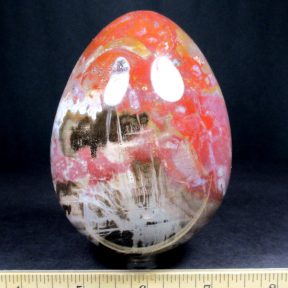
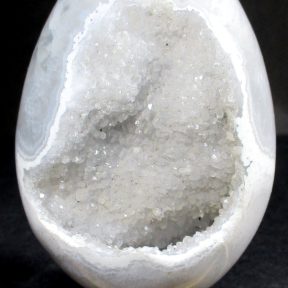
Here is a nice Petrified Wood egg from Madagascar. It measures
2 1/8" x 1 5/8" and a nice polish. This egg has a rich Brown and Tan
color with lighter colored natural striations and a very different crystallized
cavity area. A very nice addition to any egg collection. Petrified
Wood is a type of a fossil as it consists of fossil wood where all the organic
materials have been replaced with minerals while retaining the original structure
of the wood. These minerals are most often Silicates such as Quartz.
Other minerals, Manganese, Iron and Copper, in the water or mud during the
petrification process give Petrified Wood a variety of color ranges: black
- Carbon; green/blue - Copper; red/brown/yellow - Iron. Petrified Wood
can preserve the original structure of the wood in all its detail all the
way down to the microscopic level. Structures such as tree rings and
the various tissues are often observed features. Although Petrified
Wood can be found worldwide, it is rather rare in larger quantities and at
times can be difficult to obtain by the average collector.
|
Petrified Wood Egg
|
|

|
$9.00
|
EGG304c
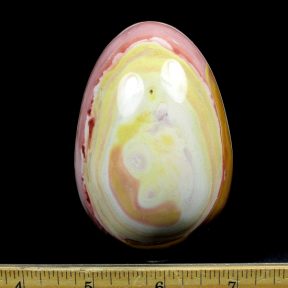
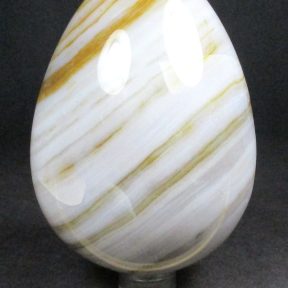
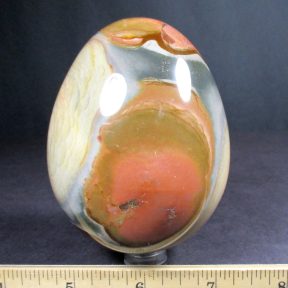
Here is a very nice, larger Onyx egg from Pakistan.
It measures 2 3/4" x 2" and has a nice polish. The egg has unique striping
design that adds the colors of White, Brown, Yellow, and Orange. Something
different for the egg collector! Another
photo.
Onyx is a banded variety of Calcite. The colors of its bands range
from white to almost every color except shades of purple, blue and black.
It is used for vases, bowls, beads, cabochons and other items. This type
of Onyx is found in Mexico and Pakistan. It is often carved, polished and
sold in a variety of different things.
|
Pakistani Onyx Egg
|
|

|
$22.00
|
EGG302b
This is a quite interesting Stromatolite egg. It
measures 2" x 1 1/2" and has a nice polish. This material is very dense
so these eggs are very heavy in relation to size. Something different
for the egg collector! Another photo.
Stromatolites are one of the oldest known fossils. They are commonly
thought to have been formed by the trapping, binding, and cementation of sedimentary
grains by microorganisms, especially blue-green algae but very few actually
contain fossilized microbes.
|
Stromatolite Egg
|
|

|
$12.00
|
EGG305b
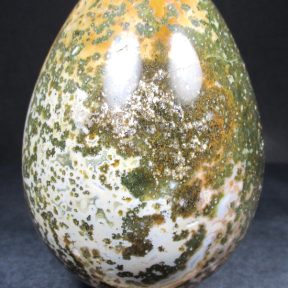
This is a very nice egg from carved from Fossil Rock
material from Morocco. It measures 2 5/8" x 2" and has a nice
polish. The egg was hand carved so it has flat spots or is not
perfectly shaped like most other eggs. It has a great Orthoceras black,
grey and white color mix.
Another photo.
Ammonites are an extinct group of marine animals of the subclass
Ammonoida in the class Cephalopoda, phylum Mollusca. They are excellent
index fossils which are fossils that are used to define and identify
geologic periods. Ammonites' closest living relative is probably not the
modern Nautilus (which they outwardly resemble) but rather the subclass
Coleodiea, which are octopus, squid and cuttlefish.
|
Orthoceras
Egg
|
|

|
$35.00
|
EGG303c
Here is a unique Leopard Skin Jasper egg. It
measures 2 1/4" x 1 5/8" and has a real nice polish. This material is
unique in that it resemble the furry coat pattern of a leopard. The
egg has a great color and design. The material is from Peru.
Leopard Skin Jasper is one of the many varieties of Crypto-Crystalline
Quartz, which includes others such as Agates, Chalcedony and other Jaspers.
It is obviously appealing characteristic is the splotchy pattern that is reminiscent
of a leopard's coat. It makes an attractive and unusual stone for unique
art and decoration. It is sometimes referred to as "conglomerate" rock
or stone.
|
Leopard Skin Jasper Egg
|