|
Page 7
|
Cost
|
Item
Description
|
thinner long image
|
Click Picture
for Larger Image
|
|

|
$32.00 |
M700b
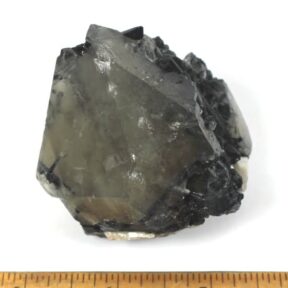
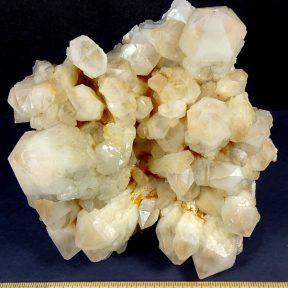
Here is a very nice, above average quality Smokey Quartz cluster
specimen. It measures 4 3/4" x 4" x 1 1/2" and has a natural shiny appearance.
These Crystals have been irradiated which enhances the dark Brown to Black
color. An amazing work of nature.
Another photo
Quartz is the second most common mineral in the Earth's continental
crust. It is mainly composed of Silica or Silica based minerals.
Although Quartz is known by a variety of names, the most important distinction
between types of Quartz is that of macro-crystalline, individual crystals
visible to the unaided eye, and micro-crystalline, where aggregates of crystals
are only visible under high magnification. There are many forms of Quartz
including Chalcedony, Amethyst, Citrine, and Carnelian which are results of
mineral impurities or heat treatments.
|

Smokey Crystal Quartz
|
 |
$140.00 |
M701b
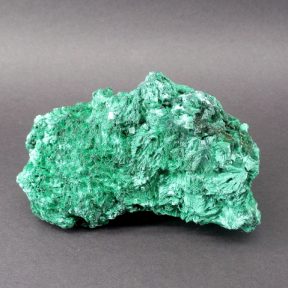
Here is a larger specimen of natural Malachite in the rough.
It measures 6 3/4" x 6 1/2" x 4 5/8" and is not polished. This interesting
mineral has a frosty Green that surrounds a Grey matrix. Close observation
will reveal some very nice, light to medium Blue Azurite mixed in with the
Malachite. Another photo
Another photo
Malachite is a Copper Carbonate mineral that often forms botryoidal,
fibrous or stalagmitic masses. It is often the result of the weathering
of Copper Ores and is commonly found with Azurite, Goethite and Calcite.
It is typically associated with Copper deposits including Limestone which
is the source of the Carbonate. Malachite is found in many regions world
wide and is usually shaded green in color.
|

Malachite
|
|

|
$100.00 |
M702b
This is something different from the Rock Shed's mineral department.
Here is a very nice, above average quality Sphalerite and Calcite combination
mineral. The mineral measures 7 1/2" x 5 1/2" x 4 1/2" and has a naturally
shiny luster. The mineral has several unique Sphalerite Crystals resting
on a Grey Limestone matrix with tiny sugar-like Calcite Crystals. Very
unique and very special. Another photo
Sphalerite is a mineral that is the chief ore of Zinc. It consists
mainly of Zinc Sulfide in crystalline form but almost always contains valuable
Iron. When the Iron content is high, it is an opaque black variety called
Marmatite. It is usually found in association with Galena, Pyrite, Calcite,
Dolomite and Fluorite. It is usually yellow, brown or gray to gray-black
in color and may have a shiny or dull luster or sheen.
Calcite is a Carbonate mineral that is most widely distributed on the
Earth's surface. It is a common constituent of sedimentary rocks with
Limestone in particular. A Calcite formation can take on many different
shapes and sizes which is dependent on the location, ground water occurrence
and temperature. Calcite is usually white or colorless but can be gray,
red, yellow, green, blue, violet, brown or black. The deeper the color
is usually indicative of the definitive impurities from the earth or water.
|
Sphalerite - Calcite
|
|

|
$80.00 |
M703c Here is something different
for the mineral collector. This is an above average quality Silver specimen
in matrix. It measures 3 1/4" x 2" x 1/4" and has not been polished.
The Silver is located on the end of the triangular-shaped matrix piece and
has a shiny luster. This material is from Silverfields Mine in the Cobalt
area of Ontario, Canada.
Another photo.
Silver is a metallic element that is a soft, lustrous metal with a high
electrical conductivity. The metal occurs naturally in its pure, free
form or as an alloy with Gold and other metals. Silver has long been
valued as a precious metal and is used to make ornaments, jewelry, high-value
tableware, utensils - thus silverware, and currency coins.
|
Silver
|
|

|
$28.00 |
M704b
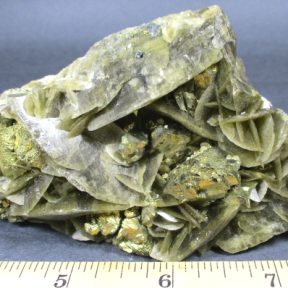
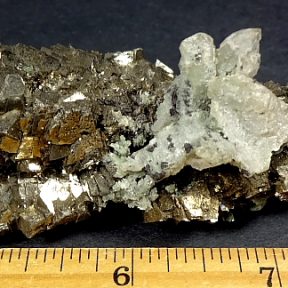
This is an interesting mineral combination! Here is an
Apophyllite-Stilbite mix. This fantastic mineral measures 4" x 4" x 2 1/4"
and has a super sparkly appearance. It has a very unique White and Green
Apophyllite cubical Crystal that rests in a bed of Cream colored Stilbite
Crystals. Close observation may reveal some slight 'bruising' which
is due to the retrieval of the mineral in the mines of India.
Another photo
Stilbite is another Silicate mineral from the Zeolite family.
It is often characterized by its sheaf like aggregates. The color is
usually white and when the cleavage is perfect, will have a distinct pearly
luster.
Apophyllite, also a Zeolite, is Silicate mineral with very well defined
clear Crystals and is very popular as a collector's mineral. The Crystal
structure will refract like in obvious rainbows and can form "natural pyramids"
when tumbled.
|
Apophyllite - Stilbite
|
|

|
$15.00 |
M705b
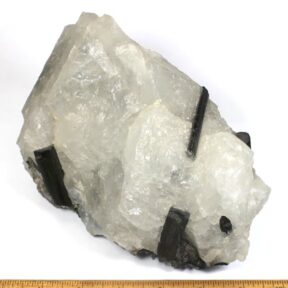
Tourmaline from the Black Hills of South Dakota!! Here are
several, very nice
specimens of Black Tourmaline resting in a Mica Schist set in a rock matrix.
The mineral measures 6 3/4" x 2 5/8" x 4 1/4" and has not been polished. Close observation
will reveal several areas of Crystal Quartz as well. Very interesting
and different. Another photo
Another photo
Tourmaline and the Tourmaline mineral group is chemically one of the
most complicated groups of Silicate minerals. Its composition varies
widely with Sodium, Calcium, Iron, Magnesium, Lithium, Aluminum, Boron and
other elements. It has a wide variety of colors including black, blue-black,
brown, yellow, red, green, pink and is rarely colorless. This mineral
is found in igneous rocks, like Granite Pegmatite, and metamorphic rocks such
as Schist and Marble.
|

Tourmaline in Mica Schist
|
|

|
$25.00 |
M706c
This is an interesting mineral combination!
Here is an Apophyllite-Stilbite mix. This fantastic mineral measures 4 1/2"
x 3 1/2" x 2" and has a super sparkly appearance. A great way to begin
your mineral collection with a smaller collection all in one!! Stilbite
is another Silicate mineral from the Zeolite family. It is often characterized
by its sheaf like aggregates. The color is usually white and when the
cleavage is perfect, will have a distinct pearly luster.
Apophyllite, also a Zeolite, is Silicate mineral with very well defined
clear Crystals and is very popular as a collector's mineral. The Crystal
structure will refract like in obvious rainbows and can form "natural pyramids"
when tumbled.
|
Apophyllite-Stilbite
|
|

|
$15.00 |
M707c Tourmaline
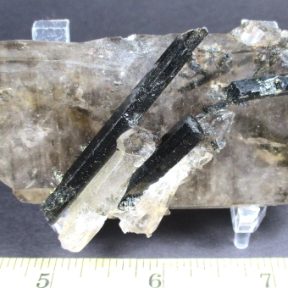
from the Black Hills of South Dakota!! Here are several, super nice specimens of Black Tourmaline
resting in a Mica Schist set in a rock matrix. The mineral measures
4 5/8" x 4 1/4" x 2 3/8" and has not been polished. Close observation will
reveal several areas of Crystal Quartz as well. Very interesting and
different.
Another photo
Another photo
Tourmaline and the Tourmaline mineral group is chemically one of the
most complicated groups of Silicate minerals. Its composition varies
widely with Sodium, Calcium, Iron, Magnesium, Lithium, Aluminum, Boron and
other elements. It has a wide variety of colors including black, blue-black,
brown, yellow, red, green, pink and is rarely colorless. This mineral
is found in igneous rocks, like Granite Pegmatite, and metamorphic rocks such
as Schist and Marble.
|
Tourmaline in Mica Schist
|
|

|
$25.00 |
M708b
Here is something different for the mineral collector. This is
an above average quality Erythrite specimen in matrix. It measures 2
5/8" x 2 1/4" x 3/4" and has not been polished. The
Erythrite is interspersed
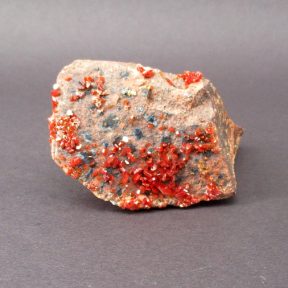
throughout the matrix piece and has a shiny bright Reddish Purple luster. This material is
from Morocco. Another photo
Erythrite occurs as a secondary coating on arsenide minerals and is
a bright crimson pink in color. The bright color or "Cobalt Bloom" was
used to spot cobalt veins of ore. Most Erythrite is found in the form of
crusts but specimens from Morocco have larger crystals of the unique
and attractive red-purple color.
|
Erythrite
|
|

|
$28.00 |
M709b
This is a nice Cervantite and Barite specimen. It measures 4 5/8"
x 2 1/4" x over 1 1/2" and has a nice natural sparkly appearance. This
Crystal cluster has several very well defined Crystal points with very clear
facets. This specimen is from the Xikuangshan Mine in the Hunan province
of China.
Another photo
Barite is a mineral consisting of Barium sulfate and is generally white
or colorless. It is used in the manufacture of paints and paper.
Although Barite contains a 'heavy' metal, Barium, it is not considered to
be a toxic chemical because of its extreme insolubility.
|
Cervantite - Barite
|
|

|
$35.00 |
M710c
Here is an above average quality
specimen of Pink Tourmaline from Brazil. The mineral measures nearly
3 1/2" x 2 3/8" x over 3" and has a nice sparkly appearance. It has many
deep Pink colored crystals in an unique pattern. Very nice.
Another photo
Another photo
The Tourmaline mineral group is chemically one of the most complicated
groups of Silicate minerals. Its composition varies widely with Sodium,
Calcium, Iron, Magnesium, Lithium, Aluminum, Boron and other elements.
It has a wide variety of colors including black, blue-black, brown, yellow,
red, green, pink and is rarely colorless. This mineral is found in igneous
rocks, like Granite Pegmatite, and metamorphic rocks such as Schist and Marble.
|
Pink Tourmaline
|
 |
$30.00 |
M711b
Here is a very nice, very interesting specimen
of Calcite from Morocco. It measures 5 1/2" x 3 1/2" x 2" and has a
deep Teal Green, Orange Gold, Sparkly White and shiny Grey mix of colors.
Most of the specimen is Calcite which shows the majority of the unique colors
originate. Close observation on the sides will reveal the sparkly, shiny
Galena material. Some of the Calcite Crystals have been slightly broken
or damaged but do not distract from the overall beauty of the mineral.
Another photo
Another photo
Calcite is a Carbonate mineral that is most widely distributed on the Earth's
surface. It is a common constituent of sedimentary rocks with Limestone
in particular. A Calcite formation can take on many different shapes
and sizes which is dependent on the location, ground water occurrence and
temperature. Calcite is usually white or colorless but can be gray,
red, yellow, green, blue, violet, brown or black. The deeper the color
is usually indicative of the definitive impurities from the earth or water.
Galena is the natural mineral form of Lead Sulfide. It is the most important
Lead ore mineral and is one of the most abundant and widely distributed sulfide
minerals. It is often associated with Sphalerite, Calcite and Fluorite.
Galena deposits often contain significant amounts of Silver, Zinc, Cadmium,
Antimony Arsenic and Bismuth. It is used as a semiconductor in early
wireless communication systems. It is usually dark grey to black in
color with a shiny iridescence.
|
Calcite-Galena
|
|

|
$50.00 |
M712b Here is a very
nice, larger specimen of Stibnite and Calcite. It measures 3 1/2" x
3 3/4" x 2 7/8" and has many sparkly Stibnite and Calcite crystals.
This mineral is from China. This specimen is a beautiful work of nature
and very fragile.
Another photo
Another photo
Stibnite, also known as Antimonite, is a Sulfide mineral that forms
grey Crystals. It is the most important source for the rare Metalloid
Antimony. It is used in the manufacture of fireworks, batteries, safety
matches and mascara.
Calcite is a Carbonate mineral that is most widely distributed on the
Earth's surface. It is a common constituent of sedimentary rocks with
Limestone in particular. A Calcite formation can take on many different
shapes and sizes which is dependent on the location, ground water occurrence
and temperature. Calcite is usually white or colorless but can be gray,
red, yellow, green, blue, violet, brown or black. The deeper the color
is usually indicative of the definitive impurities from the earth or water.
|
Stibnite-Calcite
|
|

|
$18.00 |
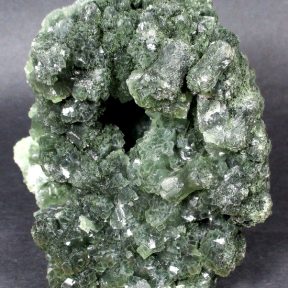
M714c Here is a very
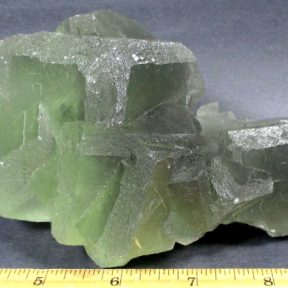
nice specimen of Fluorite from the Hunan province of China. It measures
2 3/4" x 2" x nearly 1 1/4" and is a lovely green color with Calcium
mixed in. This specimen is a beautiful work of nature.
Another photo
Another photo
Fluorite, also referred to as fluor-spar, is a mineral composed of Calcium
Fluoride. It is a widely occurring mineral found world wide and is often
found with metallic minerals such as Galena, Sphalerite, Barite, Quartz and
Calcite. Fluorite may fluoresce strongly in ultraviolet light which
may be due to the presence of some impurities such as Yttrium. Blue
is the most common color but red, purple, green, yellow and white are also
frequent. It can be used in high performance telescopes, camera lens,
enamels and in the making of opalescent glass.
|
Fluorite
|
|

|
$30.00 |
M713c Here is a very
unique Pyrite specimen in an oval like shape. It has nice larger well defined
Pyrite crystals around the outer edge with smaller ones in the center.
It measures 2 5/8" x 1 3/4" x 5/8". This is a one-of-a-kind mineral for the
one-of-a-kind mineral collector.
Another photo.
Pyrite, or Iron Pyrite, is an Iron sulfide with isometric Crystals that
usually appear as cubes. It is brittle and can break or powder easily.
Its metallic luster and brass yellow hue have earned it the nickname of "fool's
gold" due to many miners mistaken it for the real thing. Ironically,
small quantities of actual gold are sometimes found in Pyrite. It is
the most common of the sulfide minerals and is usually found with other sulfides
or oxides in Quartz veins, sedimentary or metamorphic rocks.
|
Pyrite
|